
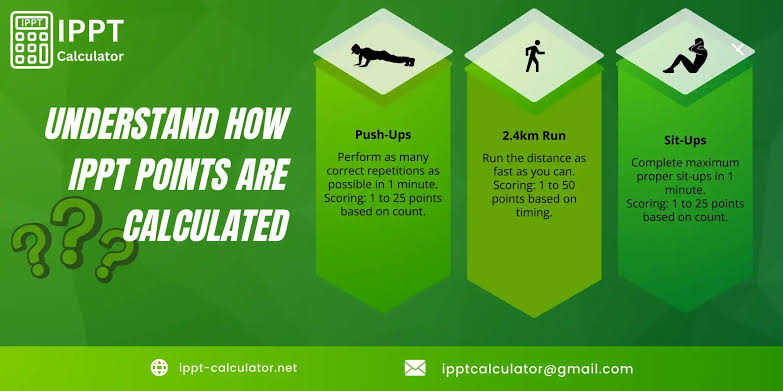
Every year, female Regulars in the Singapore Armed Forces sit for the Individual Physical Proficiency Test, better known as the IPPT. For many of them, the fastest way to figure out where they stand is by using an IPPT calculator for women. Instead of manually flipping through scoring charts and doing the maths by hand, this simple tool lets a person plug in her age, timing, and repetitions to instantly see her total score, her award category, and how close she is to the next milestone. This article walks through what the test involves, how the calculator works, and why it has become such a handy companion for anyone preparing for test day.
What Is the IPPT and Who Needs to Take It?
The IPPT is a fitness assessment designed to measure a person’s strength, core endurance, and cardiovascular fitness. For women, it typically covers three stations: bent-knee push-ups, sit-ups, and the 2.4km run. Each station is scored individually, and the combined result determines the overall outcome. Female Regulars are required to sit for this test annually to demonstrate that they remain combat-fit, while many others choose to attempt it simply to track their personal fitness progress. Because the scoring standards shift depending on age group, it isn’t always obvious at a glance how a particular performance translates into points, which is exactly the gap an IPPT calculator for women is built to fill.
How the IPPT Calculator for Women Works
At its core, the calculator takes three pieces of information: the number of push-ups completed, the number of sit-ups completed, and the time taken to finish the 2.4km run. Once a woman enters her age and these three results, the tool cross-references them against the official scoring bands and returns a total score out of 100. It also flags which award tier that score falls into, whether that’s a Pass, Silver, or Gold. Because everything is automated, there’s no need to squint at a printed chart or second-guess which age bracket applies. This makes the calculator especially useful for anyone who wants a quick, reliable snapshot of their fitness standing without wading through paperwork.
Breaking Down the Three Test Stations
Bent-Knee Push-Ups
This station is worth up to 25 points and tests upper body strength. The knees stay on the ground throughout, the back remains straight, and the chest should lower until it’s roughly a fist’s distance from the floor before pushing back up with elbows fully locked. Good form matters here just as much as raw repetitions, since sloppy technique often means reps don’t get counted.
Sit-Ups
Also worth a maximum of 25 points, the sit-up station is completed within one minute. The hands cup the ears, the elbows must touch the knees at the top of each rep, and the shoulder blades need to touch the mat on the way down. It’s a station that rewards a steady rhythm rather than a frantic burst of energy.
The 2.4km Run
The run carries the heaviest weight of all three stations, worth up to 50 points, which makes it the single biggest factor in the final score. Timing standards are calibrated specifically for female physiology and vary by age group. Because this station holds half of the total points available, many women find that improving their run time has the biggest overall impact on their final result, which is precisely the kind of insight an IPPT calculator for women can highlight instantly.
Age Groups and Scoring Bands
The scoring system recognises that fitness benchmarks naturally shift with age, so the standards are broken down into fourteen separate age divisions, ranging from under 22 all the way through to the 58 to 60 bracket. A score that earns Gold for one age group might land in the Silver or Pass range for another, which is why manually cross-checking a chart can get confusing fast. A well-built calculator removes that guesswork entirely, automatically applying the correct standard for the age entered.
Why an Online Calculator Beats Manual Scoring
Doing the maths by hand isn’t impossible, but it does open the door to small errors, especially when someone is tired after a workout and just wants a quick answer. An online calculator keeps things consistent every single time, applies the right age bracket without fail, and saves a good chunk of time. It also makes it much easier to experiment with “what if” scenarios, such as checking how many more sit-ups would be needed to bump a Silver result up to Gold, or how much the run time would need to improve to gain those extra points.
Tips for Improving Your IPPT Score
Since the run carries the most weight, interval training tends to produce faster improvements than sticking to a steady, unchanging pace. Alternating bursts of higher intensity with recovery periods helps build both speed and stamina more efficiently. For push-ups and sit-ups, practising with correct form from the start avoids wasted reps that don’t get counted on test day. Consistency matters too, but as many trainers point out, consistency without progression is really just maintenance. Gradually increasing reps, sets, or pace over the weeks leading up to the test tends to produce noticeably better results than repeating the same routine without adjustment.
Using the Calculator to Set Realistic Goals
One of the most practical benefits of an IPPT calculator for women is that it turns an abstract goal like “get fitter” into something measurable. A woman can enter her current numbers, see her present score, and then work backwards to figure out exactly what improvement she needs in each station to reach her target award. This kind of clarity tends to make training feel a lot more purposeful, since every extra rep or every second shaved off the run time has a visible, quantifiable payoff.
Final Thoughts
The IPPT can feel like a lot to keep track of between three different stations, fourteen age brackets, and shifting point thresholds. An IPPT calculator for women simplifies all of that into a few quick inputs and an instant, accurate result. Whether someone is training for their annual test or simply curious about where their fitness currently stands, leaning on a calculator instead of manual charts saves time, reduces errors, and makes it a lot easier to stay motivated toward that next award tier.